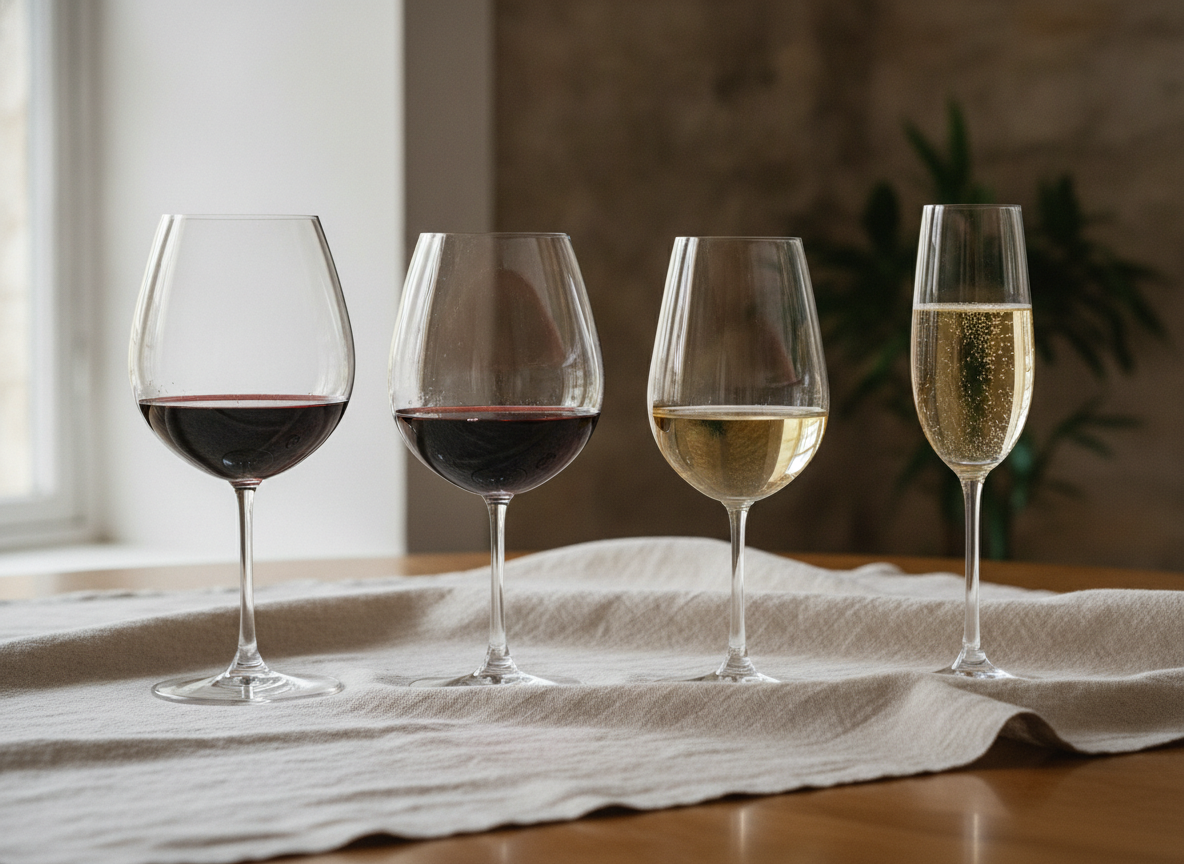
Two glasses cover almost everything. The rest is for show.
Glassware affects perception of wine more than most casual drinkers expect, and less than most catalogues claim. The shape concentrates aromatics at a particular point above the rim, and the bowl size determines how much swirling oxygenates the wine. Beyond those two effects, marginal returns drop off sharply.
What you actually need
Two glasses, in any honest household. A medium-bowled red glass (around 600ml capacity, never filled past one-third) and a smaller white glass (around 350ml, filled to one-third). That covers reds, whites, rosés, and most fortified wine. A flute is the third one if you drink Champagne regularly — although a small white glass is genuinely better for serious Champagne.
Specialised shapes
Burgundy glasses (large, balloon-shaped) help highlight the perfume of Pinot Noir and old white Burgundy. Bordeaux glasses (taller, narrower) suit structured Cabernet-based reds. The difference is real but modest — perhaps 10% perceptible improvement, in our experience. The marketing claims of “varietal-specific” glasses for every grape are mostly that: claims.
What matters more than shape
Cleanliness. A glass washed with detergent and stored upside-down in a closed cupboard can hold residual soap or musty notes that distort everything. Hand-wash with hot water, no detergent, dry with linen, store rim-up.
Fill level matters too. Most wine glasses are designed to be filled to the widest part of the bowl — not higher. The empty space above the wine is where the aromatics gather.